The Invisible Drain: The True Cost of Losing Your Entry-Level Sales Talent
High turnover among Sales Development Representatives (SDRs) and Inside Sales Representatives (ISRs) is often accepted as a cost of doing business. Because these are entry-level roles, leadership frequently miscalculates the exit of a rep as a minor operational hiccup.
The reality? The financial drain is immense, and much of it is hidden beneath the surface.
When an SDR or ISR walks out the door, you aren’t just losing an employee; you are losing momentum. The true cost of attrition spans recruitment fees, lost pipeline, and a prolonged Time-to-Productivity (TTP) for their replacement. While a new hire is ramping up to full quota capacity, territory goes uncovered, leads grow cold, and the burden shifts to remaining team members, damaging morale.
To break this cycle, organizations must pivot from viewing entry-level sales as a revolving door to treating it as the foundation of their future leadership pipeline.
Retaining Talent Through Value and Connection
Even though some turnover in entry-level staff is inevitable, a significant portion can be prevented by making reps feel genuinely valued. Giving them a clear vision of their career progression and providing elite development are the strongest retention tools available.
A prime example of this investment is hosting an Annual ISR and SDR Bootcamp. Bringing reps together creates crucial bonding opportunities that build cultural loyalty. It serves as a high-energy platform to align the team on the latest product innovations and industry know-hows, transforming a isolated, high-stress job into a shared mission.
However, a great bootcamp is only the launchpad. To systematically reduce attrition, organizations must excel across five core pillars of talent development:
1. Onboarding & Time-to-Value
Reducing Time-to-Ramp requires moving past the outdated “firehose” method. Successful onboarding relies on Role-Based Competency Modeling, defining the exact skills needed for an SDR to excel versus an AE. Crucially, onboarding must transition into Everboarding—continuous, structured learning paths that treat growth as an ongoing journey rather than a one-time event.
2. Core Skill & Capability Architecture
Modern buyers demand sophisticated sellers. Reps must be trained in Commercial Acumen to understand buyer business models, and Value-Based Selling to articulate ROI rather than just pitching features. Furthermore, equipping reps with Buyer-Centric Orchestration and Digital/Social Selling strategies ensures they can navigate today’s complex, non-linear B2B buying journey.
3. Continuous Coaching & Leadership Pipeline
Enablement fails without the frontline. Implementing structured Sales Coaching Frameworks empowers Front-Line Managers (FLMs), who are often the bottlenecks of development. Robust FLM enablement ensures managers can effectively coach reps daily and accurately execute High-Potential (HiPo) Identification to spot future strategic leaders early.
4. Performance Optimization & Retention
To minimize attrition, reps need to see their future. A transparent Sales Competency Framework maps specific skills directly to career milestones, showing reps exactly how to earn their next promotion. By leveraging data-driven Skill Gap Analysis, managers can pinpoint exactly where a rep is struggling (e.g., discovery vs. objection handling) and apply Continuous Reinforcement—like micro-learning—to beat the post-training forgetting curve.
5. Measurement, Tech, & Analytics
To prove the ROI of talent development, leadership must track Sales Proficiency Metrics (e.g., pitch-check pass rates) and use Correlation Analytics to tie training directly to lagging indicators like win rates and quota attainment. Integrating Just-in-Time Enablement directly within the CRM provides guided selling plays precisely when a rep needs them during a live deal cycle.
Sustaining Growth Beyond the Classroom
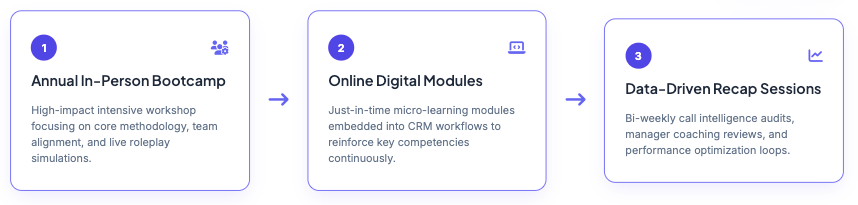
The Modern Training Ecosystem: A successful learning strategy blends the high-energy impact of in-person events with the scalable precision of digital execution.
While the annual bootcamp builds community and resets the baseline, long-term mastery requires a robust digital follow-through. Rolling out ongoing training modules online allows reps to learn at their own pace without disrupting their daily outreach.
By closely monitoring digital progress and engagement analytics, enablement teams can spot when individuals or entire cohorts are stalling. When the data flags a collective dip in understanding, targeted recap sessions can be deployed immediately to reinforce the material, course-correct behavior, and protect the organization’s revenue pipeline.